EARN 3 CE CREDIT HOURS
Death Communication®
Death Communication® is an on-demand, self-paced CAPCE-accredited online CE course that teaches you how to give clear, compassionate, and respectful death notifications to the survivors of deceased patients.
Despite our best efforts, 90% of our cardiac arrest patients will die.
Frustratingly, death notifications training isn’t yet a standard part of state or national curriculum for first responders—or any healthcare professional. Emergency medical staff must often be the bearers of shocking and upsetting news, but the majority of us aren’t educated about the basic elements of a successful death notification. Our lack of training can have negative consequences for survivors, the organizations we represent, our own mental health, and the long-term resilience of our professional teams.
Death Communication® is the most sought after death notifications training resource created to remedy this gap in your training. Through psychology-backed death notification guidelines, examples, and practical “do’s and don’ts”, you’ll complete this CAPCE CE course with actionable knowledge of what survivors need most from you during and after a death notification. Plus, 3 CE credits!
student reviews
real students.
Career-Changing
experiences.
Daren K.
Geraldine H.
Casey H.
Greg Z.
Dion P.
Aaron W.
Talia H.
Angel M.
Pamela L.
Rose M.
Garrett Y.
Richard Q.
Cynthia D.
Jennifer V.
Jessica R.
Jessica W.
You'll Learn...
- How to deliver a 4-step death notification and how you can communicate more clearly and compassionately with family, survivors, and bystanders.
- What you should NEVER say during a death notification and what to say instead. Plus, downloadable cheat sheets for easy reference!
- Why proper handling of death notification is important—how it can impact outcomes for survivors, yourself, your team, and the agency or organization you represent.
- How staying on-scene for a few minutes longer can help survivors find closure and feel more at peace with the outcome.
- Special considerations, like handling pediatric death notifications or other sensitive situations.
- How to identify different types of grief in survivors, yourself, and your colleagues. Grief takes many forms!
- Natural physical and mental responses to grief that occur due to stress hormones.

COURSE curriculum
Explore below to see what's included in this online CE course
1.1 Why It’s YOU’RE Job.
2.1 Grief Injury
2.2 Types of Grief
2.3 Ritual. Community. Oxytocin.
3.1 Needs of the First Responder
3.2 Needs of the Family/Bystander/Survivors
3.3 Stress and the Brain
4.1 Scene Variables
4.2 Pediatrics
4.3 Grief and the First Responder
5.1 What to Expect
5.2 Things to Do
5.3 Say This, Not That
5.4 Four Step Death Notification
B.1 Meet Ben
B.2 Deconstructing PTSD
B.3 EMDR, Proactive Solutions, and the Terrible Ten

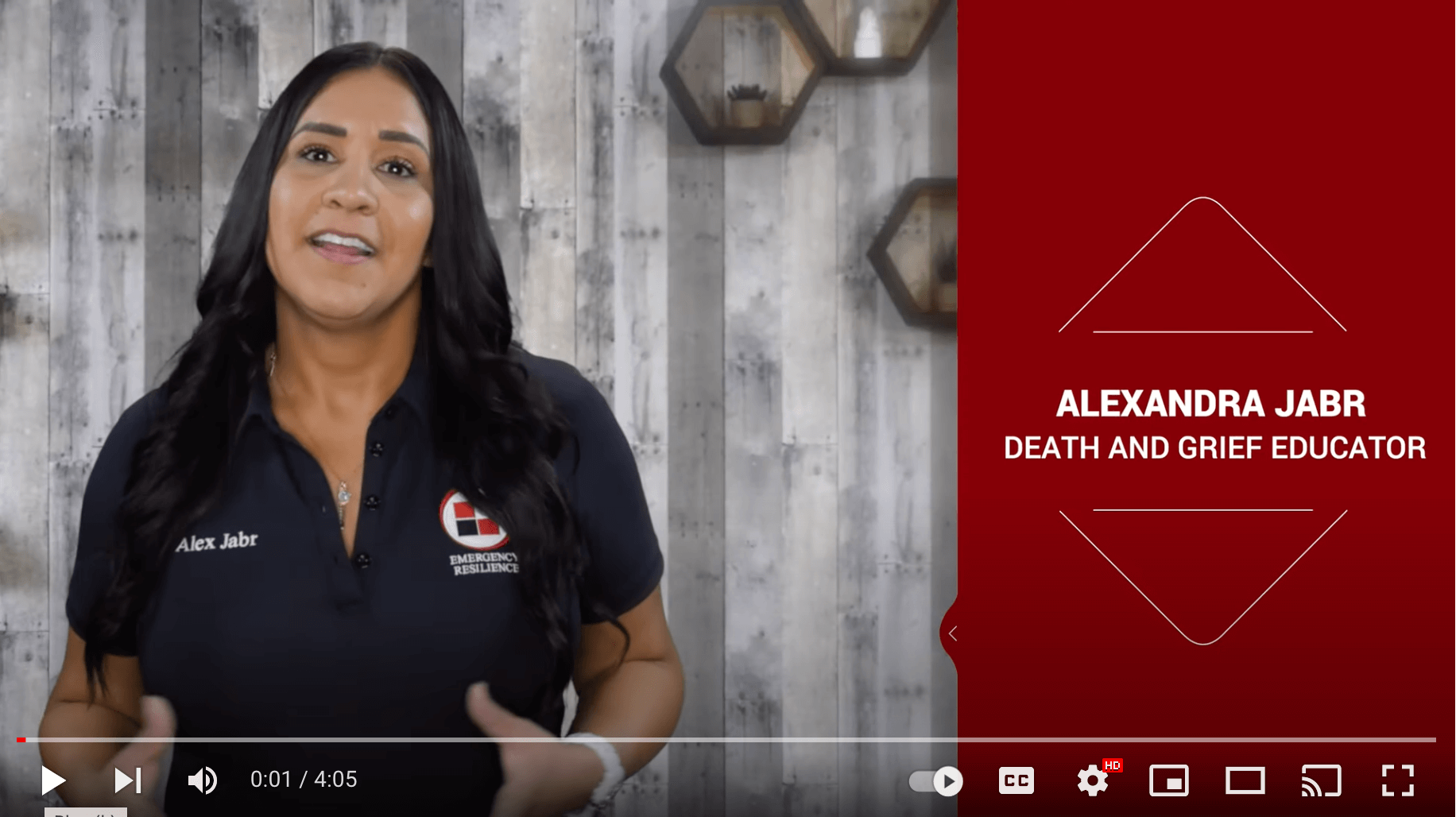
Meet Your Instructor
Alexandra Jabr, PhD & EMT-P
Hey there!
I’m Alex, founder and lead instructor at Emergency Resilience. My journey in EMS started back in 2003, and over the years, I’ve worn many hats—EMT, paramedic, cardiac tech, EMS Coordinator, and EMS Educator.
After nearly 15 years in the field, I decided to dive deeper into the human side of our work. I earned a Master’s in Death, Grief, and Bereavement, followed by a Ph.D. in Depth Psychology. This gave me a richer understanding of the emotional and psychological challenges we face as first responders—and how we can protect our mental health to better serve our patients, grieving families, and our own teams.
It also served as the basis for this course, Death Communication! My passion is creating space in the CE world for courses that go beyond the usual “core training.” Because, let’s face it, career growth as a first responder is about so much more than CPR re-certs and NREMT refreshers.
I intend for Death Communication to help you be better prepared to give unfortunate news. When you have the tools you need, it can make even the hardest conversations a little more manageable.
Chat Soon,
Alexandra Jabr
online ce courses for groups
Purchase this course for your Agency, Organization, or Department
Educate and empower your team with our online CAPCE ce courses for groups! Each team member will receive their own unique login, CE credits, and certificate of completion. Plus, you can monitor progress to help your team stay on track toward their goals.
Have a unique need or challenge within your department that we don’t address in our training?
We also offer customized online and in-person trainings for groups, taught by our lead instructor, Dr. Alexandra Jabr.
Other Online Ce courses from emergency resilience
$13 | 1 CE Credit Hour
What are the facts and myths behind the Lazarus Phenomenon? What are the implications of “auto-resuscitation” for emergency care providers? How should we respond to this ultra-rare, seemingly spontaneous medical mystery if it occurs? In this course, we’ll explore explanations for and approaches to delayed return of spontaneous circulation (ROSC).
death communications
Raising the Dead:
Managing CPR-Induced Consciousness
$33 | 2.75 CE Credit Hours
How should you manage cardiopulmonary resuscitation–induced consciousness or CPRIC? In this class, we’ll go over the possible causes of CPRIC and the ethical implications of this rare phenomenon. We’ll also review current recommendations for administering life-saving medical intervention if your patient regains consciousness during CPR.
Your
Your CUSTOM ce course from emergency resilience
CE Credit Hours TBD
Interested in contracting Emergency Resilience to adapt one of our courses to the unique needs of your department, agency, or organization? Emergency Resilience’s founder and lead instructor, Alexandra Jabr, is available for customized in-person trainings and educational speaking events. We also offer group course purchase options for our online courses.
FREE CE COURSE NOW AVAILABLE | 2 CE Credit Hours
Ketamine Therapy for the Wounded Helper
Ketamine therapy is rapidly emerging as a powerful intervention for psychological injuries commonly experienced by first responders. This session takes a balanced look at the science, the stigma, and the shifting conversation around ketamine-assisted therapy. Attendees will gain practical knowledge about this psychotherapeutic tool and understand its use as an integrative approach to support mental healing and recovery.